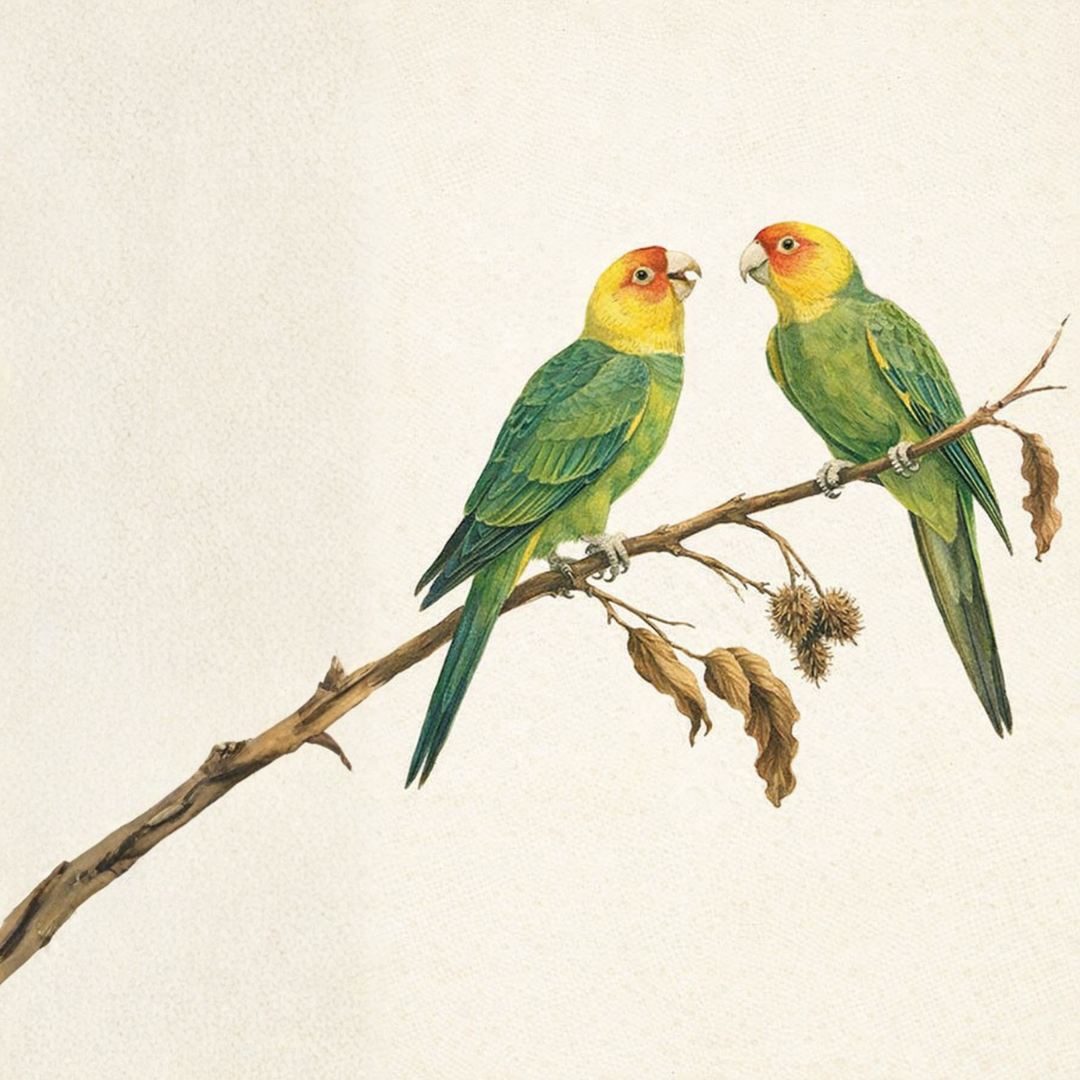
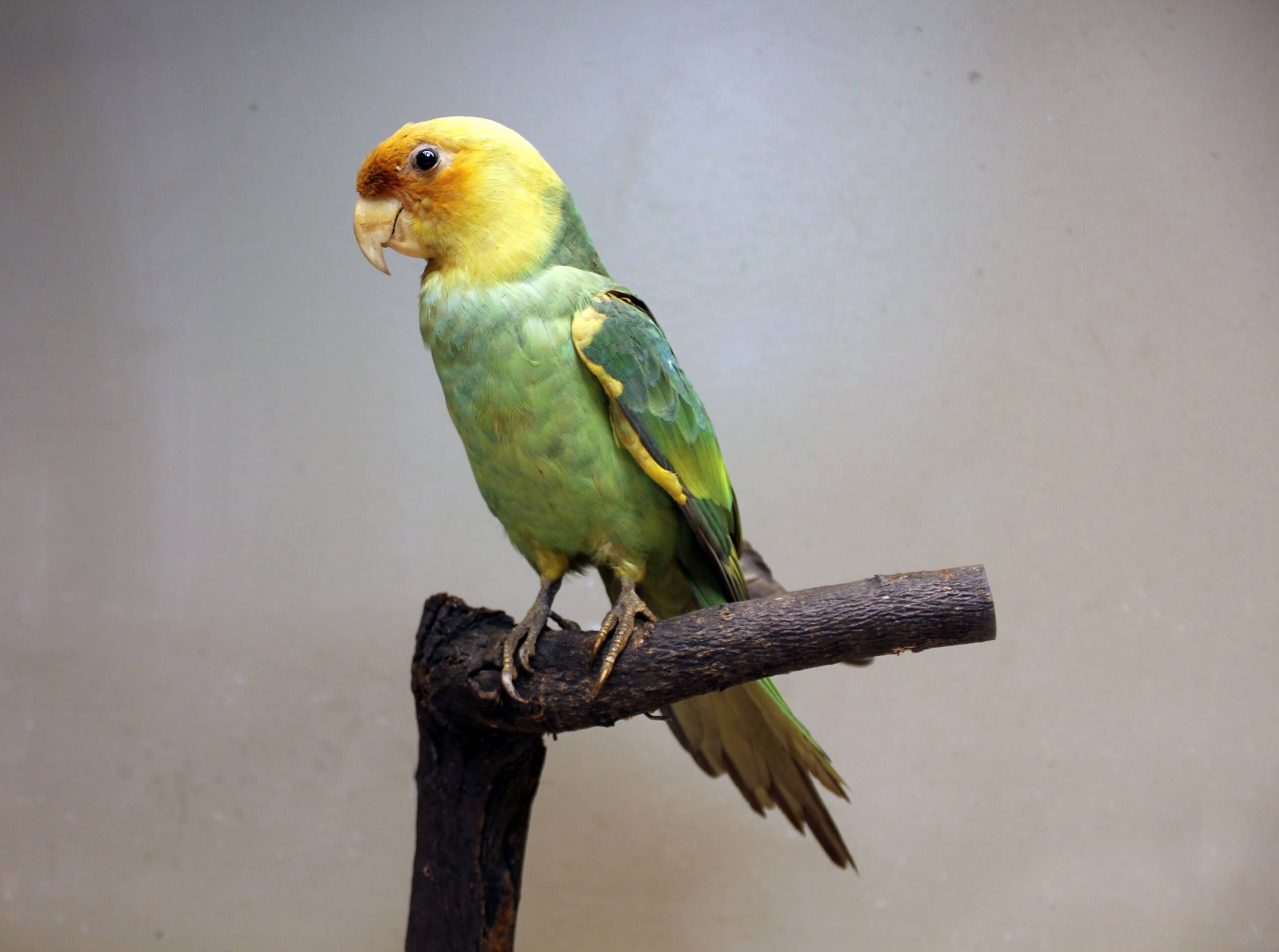
Conuropsis carolinensis belongs to the order Psittaciformes and family Psittacidae, and older literature often describes two regional forms.
Its separation from modern conures remains central to genomic comparison and phenotype reconstruction.
Status Pillar
Extinct
The last confirmed captive individual died in 1918, after credible wild observations had already sharply declined.
We treat extinction as both historical fact and a planning boundary for restoration strategy, ethics, and feasibility analysis.
Role Pillar
Ecosystem Function
Available evidence suggests the species combined seed predation and dispersal roles across floodplain forests, wet edges, and disturbance mosaics.
These inferred functions guide analog-species comparison and contemporary restoration scenario testing.
Chronology of the Lost
From Millions to Zero
A condensed timeline tracing the Carolina parakeet from mass abundance to extinction, including the human pressures that turned decline into collapse. Hover a card to isolate each inflection point against the full historical record.
1700
Peak Abundance
Range at Full Scale
Carolina parakeets likely moved through much of the eastern and southeastern United States in large, visible flocks. They were the region's only native parrot and were repeatedly described in river bottoms, orchards, and edge-rich forests where seasonal food was concentrated.
1832
Scientific Record
Recorded and Remembered
Nineteenth-century naturalists documented the species in drawings, specimen collections, and field notes. Those records preserved key taxonomic and ecological detail, but they also captured an early warning: birds were already becoming less common in parts of their historical range.
1880
Pressure Intensifies
Decline Becomes Regional
By the late nineteenth century, recurring shooting, specimen demand, and expanding land conversion were removing birds and degrading habitat at the same time. What had been local losses increasingly appeared as a regional contraction across multiple states.
1918
The Last Whisper
Last Confirmed Life
In 1918, the last known Carolina parakeet died at the Cincinnati Zoo, ending the documented living lineage. By this point, the collapse reflected decades of human-caused pressure rather than a sudden isolated event.
1939
Official Closure
Extinction Recognized
After decades without verified sightings, authorities broadly recognized the species as extinct. The official closure came later than the biological collapse, while debate continued over how hunting, habitat loss, and possible disease interacted.
2026
Modern Restoration
Restoration Frameworks
The Carolina Parakeet Project builds a transparent evidence base, range reconstruction, and comparative modeling workflow. The goal is not mythic resurrection language, but accountable science tied to both historical truth and present-day conservation utility.
The Carolina parakeet occupied a large swath of eastern North America, with records extending through the Southeast and up parts of the Mid-Atlantic and interior river systems. Seasonal and local movement likely tracked food pulses in bottomland forests and agricultural margins.
Primary Habitat
Floodplains, swamps, and edge-rich forests
Historical accounts place Carolina parakeets most consistently in bottomland hardwood forests, cypress and tupelo swamps, river margins, and heavily wooded corridors tied to major drainage systems. These were not closed-canopy interiors only; they were dynamic, light-broken landscapes with flood pulses, treefall gaps, fruiting edges, and dense seed-bearing vegetation.
The species also appears to have used disturbed ground along field edges and orchard margins when food was available, which suggests a bird comfortable moving between wild wetlands and human-modified openings. That flexibility helps explain why records span both remote swamp country and agricultural frontiers, especially in places where forest, water, and seasonal food abundance overlapped.
Strongly associated with river systems, swamp forests, and lowland hardwood mosaics.
Likely favored habitats with layered food access: seeds, fruit, mast, and weedy pioneer plants in the same territory.
Edge conditions near farms may have increased feeding opportunity while also increasing exposure to hunting and conflict.
Bottomland atmosphere and dense edge cover
Landscape Behavior
Mobile flocks moving through remembered feeding circuits
Rather than behaving like an isolated canopy specialist, the Carolina parakeet seems to have worked the landscape in coordinated flocks, repeatedly visiting productive feeding and roosting areas. Historical observers described birds moving along river corridors and returning to known sites, which points to a mental map anchored to reliable seasonal resources rather than purely random wandering.
Those movements likely connected nesting areas, feeding patches, mineral or salt-rich sites, and communal roosts. Such behavior is efficient in rich but patchy environments, yet it also creates concentration points: once a flock became predictable at a favored orchard, roost, or feeding stand, localized pressure could affect many birds at once.
Repeated use of productive sites suggests strong site fidelity and social information-sharing.
Landscape memory that once improved survival may have become a liability under sustained human pressure.
River corridors and recurrent movement routes
Diet & Behavior
Diet
A broad forager built for seeds, fruit, and tough plant matter
The Carolina parakeet almost certainly had a varied plant-based diet centered on seeds, fruits, mast, and flower or bud material gathered from both forest species and hardy open-country plants. Cockleburs are the most famous historical food item, but the wider pattern is more important: this was a bird equipped to exploit seasonal abundance across wetlands, woodland edges, and disturbed ground.
Its curved bill and dexterous feet would have made it effective at handling husks, seed heads, and clustered fruit, allowing flocks to strip a patch quickly once resources were found. Some historical records also imply feeding in orchards and cultivated spaces, reinforcing the picture of a highly opportunistic forager operating wherever dense plant productivity was available.
Probable foods included seeds of wetland and hardwood species, weedy plants, fruits, buds, and mast.
Cockleburs stand out because the birds tolerated plant toxins that deter many other animals.
Flock foraging would have let groups exploit ephemeral food patches rapidly before moving on.
Foraging surfaces, seedheads, and edge vegetation
Social Structure
Tight flock cohesion with costly loyalty under threat
Accounts consistently describe a highly social parrot: noisy, cohesive, and rarely acting as a solitary bird for long. Pairs likely formed strong bonds inside larger flock systems, while communal movement improved predator detection, route learning, and rapid discovery of feeding opportunities across large floodplain landscapes.
That same cohesion may have been catastrophic once hunting intensified. Historical descriptions repeatedly note birds circling back to injured or distressed flock members instead of scattering permanently, behavior that in a natural social setting may have maintained pair and group integrity but under firearms turned flock loyalty into a mechanism of mass mortality.
Likely organized around bonded pairs nested inside larger feeding and travel flocks.
Group vocality and coordinated movement probably helped maintain contact in dense forests and wetlands.
Social return behavior may have amplified losses once persecution became routine.
Mobile flock behavior and pair-bonded social movement
Historical Testimony
A warning from the archive
“ The extermination of the Carolina parakeet is not so difficult to understand. Although this bird once had an extensive range, it was never any thing like so abundant as the pigeon. It was a beautiful creature, slightly smaller than a dove, bright green in color, with red markings, and was sure to attract the eye of every gunner. Its plumage was valuable for millinery purposes. Furthermore, the parakeet had an extremely confiding and affectionate disposition. Like many other species of parrots, it mated for life, and the pairs were very devoted. When a gunner shot into a flock, killing and wounding a number of birds, the others would always come back seeking their lost mates, so that the whole flock was often destroyed. ”
Historical account, conservation literature context
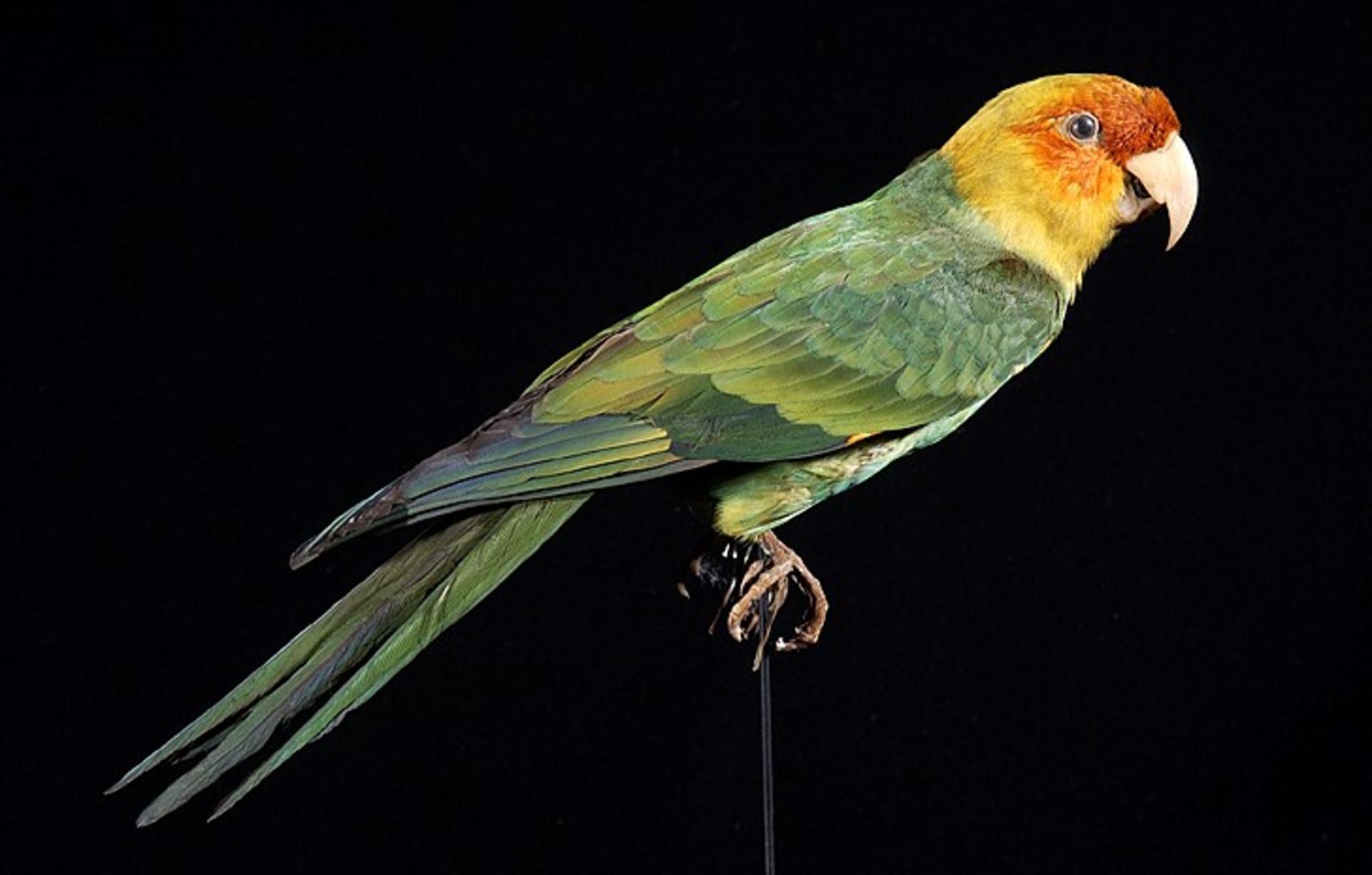
The Carolina parakeet combined a classic medium-conure body plan with unusually vivid head coloration for a North American bird. Historical plates, museum skins, and written descriptions together suggest a species built for agile, flock-based flight through wooded river systems rather than heavy-bodied ground use or short-hop canopy movement.
Body Plan
Lean conure proportions with a long, graduated tail
Most reconstructions place the Carolina parakeet in the low-30-centimeter body-length range, putting it firmly in medium-conure territory. The bird appears to have carried a slim torso, a relatively long tapered tail, and pointed wings suited to fast, coordinated flight between openings, floodplain edges, and taller woodland cover.
That combination matters because it separates the species from more compact or heavy-bodied parrots. It likely moved with the quick directional changes and strong flock flight expected of an active landscape-traveling parakeet, using the tail as both a visual signal in group movement and a stabilizing structure in maneuvering flight.
Estimated body length: roughly 31 to 33 cm in most modern summaries.
Long tail and pointed wing profile suggest strong directional control in flock travel.
Hooked bill and zygodactyl feet indicate a manipulative feeder capable of handling seeds, fruits, and husks efficiently.
Green body field with a bright yellow head and orange face
The most distinctive visual trait was the species’ color partitioning: a predominantly green body set against a yellow head and neck with orange to red-orange accents around the face and forehead. In motion, that palette would have made the birds extremely conspicuous, especially when multiple individuals turned in the light at once.
Juveniles were likely duller and greener around the head before maturing into the brighter adult pattern, while strong male-female plumage divergence is not usually emphasized in historical accounts. The result is a species identity that depended less on sex-based display and more on flock visibility, pair recognition, and a memorable, high-contrast head profile.
Body plumage was primarily green, likely functioning as cover against forest vegetation.
Head coloration created the bird’s most recognizable field mark and historical artistic signature.
Juvenile coloration likely shifted gradually toward the brighter adult head pattern.
Historical reference image for plumage pattern. By Huub Veldhuijzen van Zanten/Naturalis Biodiversity Center, CC BY-SA 3.0, Wikimedia Commons.
Size Envelope
Medium-parakeet dimensions, probably light enough for rapid flock turning but large enough to process tougher seeds and fruiting material with a strong bill.
Flight Profile
Long tail, streamlined body, and pointed wings imply a bird adapted for sustained movement between feeding patches rather than static perch-only behavior.
Age and Sex Variation
Juveniles likely showed reduced head brightness, while adults appear to have had limited sexual dimorphism compared with more strongly sex-marked parrots.
Comparisons
Interactive Extant Analog Carousel
Use the arrows or pause on hover to inspect each analog in sequence, with a shared data panel anchored at the base of the image.
01 / 04
Sun Conure
Aratinga solstitialis
Genomic sequencing and phenotype overlap place the Sun Conure as the most useful living comparison for Carolina-parakeet modeling, especially for social flock behavior and signal-rich plumage contrast.
Sun Conure
Aratinga solstitialis
Clade Position
Closest Living Relative
Modern Range
Northern South America
Size / Similarity
Medium conure (around 30 cm) High yellow/orange + green contrast overlap
IUCN Status
Endangered
Extinction Drivers
Likely multi-cause extinction process
Direct pressure
Direct human killing likely drove the earliest and most visible losses. Birds were shot as crop pests, harvested for museum and private specimen demand, and targeted repeatedly at known feeding and roosting sites. Because Carolina parakeets often stayed socially cohesive and returned to distressed flock members, each shooting event could remove many individuals rather than one, turning human pressure into rapid group-level mortality.
Habitat pressure
Human land conversion steadily removed the bottomland forests, swamp corridors, and edge mosaics this species depended on. Logging, drainage, agricultural expansion, and river-system alteration reduced nesting options and disrupted seasonal food pathways. Even where birds persisted, habitat fragmentation likely broke movement links between local flocks, weakening recovery after local declines and increasing long-term extinction risk.
Disease hypothesis
Disease remains a plausible amplifying factor, but current evidence supports caution rather than certainty. Human-modified landscapes increased contact zones among wild birds, domestic poultry, and captive animals, creating conditions where pathogen spillover could occur. Even without definitive retrospective diagnosis, disease should be treated as a potential co-driver that may have worsened decline in already stressed, human-pressured populations.
Compounded collapse
Extinction was likely not a single event but a human-driven cascade. Persistent hunting, habitat disruption, and possible disease pressure interacted with small-population dynamics until regional flocks dropped below resilience thresholds. At that stage, fewer breeding pairs, reduced genetic robustness, and broken social networks would have accelerated collapse, producing a final decline that looked sudden but had been building for decades.